Market Research and Pre Feasibility Strategy
Gateway to Humla, Nepal and the World
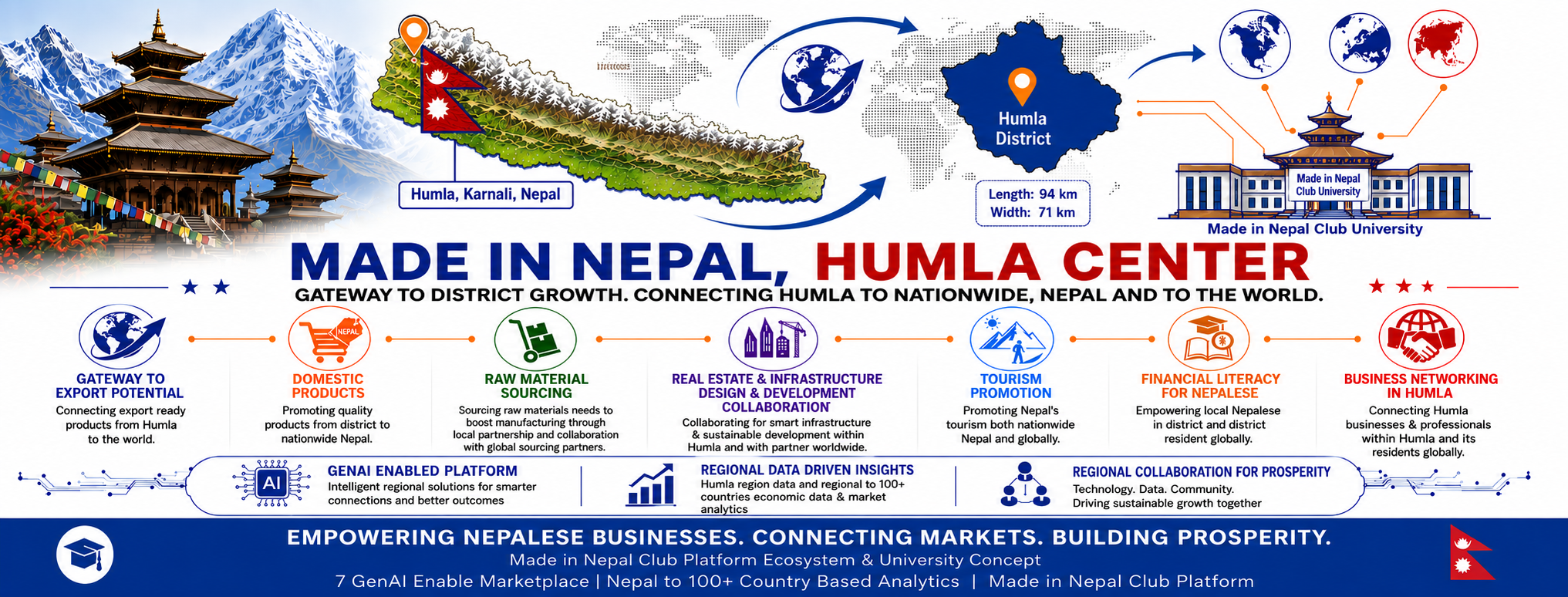
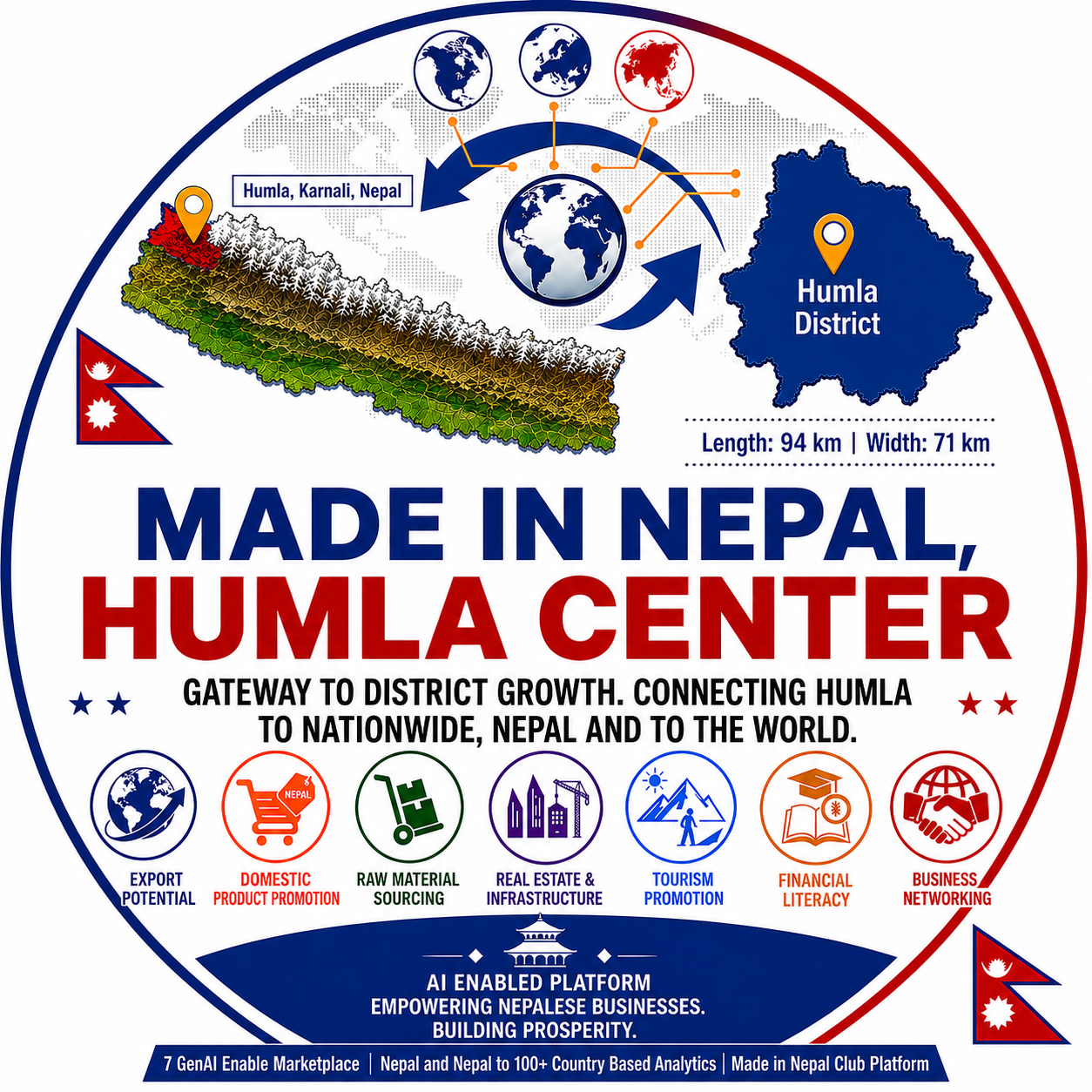
Export potential, domestic product promotion, raw-material sourcing, real estate and infrastructure collaboration, tourism promotion, financial literacy for Nepalese, and business networking across Humla, nationwide Nepal and international markets.
Humla opportunity case
Humla combines a small population with an unusually large, high-altitude territory. Nepal's 2021 census reports 55,394 residents across 5,655 square kilometres, or roughly 10 people per square kilometre. All seven local levels are rural municipalities, and Simikot is the administrative and service hub. Simikot Rural Municipality reports 11,935 residents, 2,282 households and an area of 785.89 square kilometres.[1][3]
Humla's commercial advantage is scarcity, origin and cultural identity rather than mass volume. Priority candidates include legally and sustainably sourced medicinal and aromatic plants; wool and livestock-linked goods; buckwheat, barley, potato, honey, walnut and other mountain foods; and culturally distinctive crafts. Premium domestic, diaspora and specialist international markets become plausible only when producer aggregation, traceability, grading, food safety, packaging and dependable logistics are solved together.[10][11]
Tourism is the strongest near-term service export. Humla is Nepal's gateway toward Mount Kailash and Lake Manasarovar through Hilsa. Limi Valley, monasteries, Tibetan Buddhist culture, the Great Himalayan Trail and high-mountain landscapes support pilgrimage, trekking, cultural and research travel. Nepal Tourism Board identifies skills, infrastructure, waste management, sustainable consumption and equitable benefit-sharing as central conditions for sustainable growth.[4][5]
Connectivity is improving, but it remains a major delivery risk. The Department of Roads describes the 505-kilometre Karnali Corridor as a north-south trade route. Its current concept paper reports that the 146-kilometre Sallisalla-Simikot-Hilsa track is open, 62 kilometres have been gravelled, another 21 kilometres are being upgraded to gravel, and bridge works remain in progress. Simikot Airport therefore remains commercially important for people, urgent supplies and time-sensitive tourism.[6][8]
Seven-platform market research and feasibility agenda
Global Market Access and Export Potential
Map producers and export-ready products; validate buyers before scaling; support HS-code, origin, quarantine, food-safety, packaging and logistics readiness; use QR-linked origin and batch records.
exportfromnepal.visithumla.comDomestic Product Promotion
Create a verified Humla marketplace for Nepal's cities, institutions and diaspora; bundle small producer volumes; run seasonal pre-orders; publish quality grades, dispatch windows and freight terms.
hamrosaman.visithumla.comRaw Material Sourcing and Made in Nepal Production
Build a lawful sourcing catalogue for herbs, wool, livestock inputs and mountain crops; connect cooperatives with processors; prioritize local cleaning, drying, grading and primary packaging where viable.
formadeinnepal.visithumla.comTourism Promotion
Package bookable pilgrimage, Limi cultural, trekking and educational itineraries; maintain verified permit, season, guide, accommodation, waste, safety and emergency information; distribute benefits locally.
visithimalpahadterai.visithumla.comReal Estate and Infrastructure Collaboration
Build an investible pipeline for aggregation stores, solar drying, cool storage, eco-lodges, sanitation, trails, communications and renewable energy. List no land without title, cadastral, zoning and environmental checks.
egharjagga.visithumla.comFinancial Literacy for Nepalese
Deliver NRB-aligned modules on seasonal cash flow, savings, responsible credit, insurance, digital payments, fraud prevention, remittance use, pricing and small-business record keeping.
finguru.visithumla.comBusiness Networking and Partnerships
Link all seven rural municipalities, producer groups, tourism operators, regulators, logistics firms, banks, universities, diaspora professionals, buyers and investors through a verified network.
connectingnepali.visithumla.comCommercial model and indicative 12-month pilot budget
Use a blended model: public and development partners support shared data, community skills and common-use infrastructure; enterprises pay only for optional fulfilment, promotion, documentation, training or transaction services; sponsors and diaspora partners support defined campaigns. The Center should never promise buyers, approvals, credit or investment returns.
Planning conversion: USD 1 = NPR 153.19, using Nepal Rastra Bank's selling rate shown for 14 September 2026. USD amounts are rounded, and every contract should use the transaction-date rate.[12]
| Workstream | NPR | USD | Purpose |
|---|---|---|---|
| Global market and export readiness | NPR 6,000,000 | USD 39,167 | Product mapping, buyer tests, export compliance and logistics |
| Domestic product promotion | NPR 7,000,000 | USD 45,695 | Marketplace content, campaigns, pre-orders and fulfilment trials |
| Aggregation and primary processing | NPR 8,000,000 | USD 52,223 | Grading, traceability, drying, handling and packaging pilots |
| Infrastructure and technology collaboration | NPR 10,000,000 | USD 65,278 | Pre-feasibility, prototypes, digital systems and common facilities |
| Tourism product and safety readiness | NPR 8,000,000 | USD 52,223 | Itineraries, operator skills, safety, sanitation and promotion |
| Financial literacy and enterprise coaching | NPR 3,000,000 | USD 19,584 | NRB-aligned learning and loan-readiness support |
| Networking, governance and monitoring | NPR 3,000,000 | USD 19,584 | Partnerships, inclusion, complaints and measurement |
| Indicative pilot total | NPR 45,000,000 | USD 293,753 | Release in evidence-based tranches |
Scope: This is a validation and operating pilot, excluding highways, airports, hydropower, major hotels, land acquisition and other large capital works. All amounts are planning assumptions, not quotations or funding commitments.
Twelve-month delivery plan
Form a district steering group; adopt participation and data rules; map enterprises, products, tourism operators and infrastructure gaps across all seven rural municipalities; establish legal, environmental, inclusion and grievance safeguards.
Select 20 to 30 test enterprises; prepare 10 to 15 priority products and four to six tourism itineraries; validate buyer demand and freight economics; train operators on compliance, digital safety, pricing and records.
Run domestic and diaspora pre-orders, limited buyer samples and two tourism-market campaigns; publish an investible infrastructure shortlist; track fulfilment, complaints, local benefit and environmental load.
Scale only offers that meet demand, margin, reliability and compliance tests; commission an independent review; approve a three-year plan with matched funding, local ownership and quantified safeguards.
Success measures, risks and recommendation
Year-one management targets: at least 150 verified enterprises or producer groups profiled; 50 traceable product listings; 12 qualified buyer or processor conversations; 8 bookable tourism products; 500 participants completing financial or enterprise learning; and 20 screened infrastructure concepts. These targets are for management and do not represent forecasts.
Principal risks: seasonal and expensive transport, unfinished road and bridge works, aviation disruption, restricted-area and border rules, unsustainable herb harvesting, food-safety failure, land-title error, cultural commodification, low digital trust and elite capture. Controls should include conservative fulfilment promises, lawful harvesting and origin records, testing, verified titles and permits, community consent, multilingual disclosures, grievance channels, vendor due diligence and public performance reports.
Recommendation: proceed with a 90-day validation phase led from Humla, with national and international partners serving as channels rather than owners. Release the full NPR 45,000,000 (USD 293,753) pilot only in tranches tied to verified participation, buyer validation, compliance readiness, logistics tests and community safeguards. Measure reliable transactions, local value retained, visitor quality, access to finance and trusted partnerships—not website traffic alone.
Research references
- National Statistics Office — National Population and Housing Census 2021
- District Administration Office, Humla
- Simikot Rural Municipality — Local profile
- Nepal Tourism Board — Kailash Confluence and transboundary tourism
- Nepal Tourism Board — Trekking guidance
- Department of Roads — Karnali Corridor concept paper
- Department of Roads — Hilsa-Simikot project office
- Civil Aviation Authority of Nepal — Simikot Airport profile
- Department of Immigration — Trekking routes and permit fees
- Department of Plant Resources — Medicinal Plants of Nepal
- Department of Food Technology and Quality Control — NeFFILS licensing system
- Nepal Rastra Bank — Daily foreign exchange rates
- Nepal Rastra Bank — Financial Literacy Framework 2022
- Trade and Export Promotion Centre — Export Procedures
- Department of Industry — Industry registration
- Department of Land Management and Archive
Method and limitation. This is a strategic pre-feasibility study based on published sources and platform-design assumptions. It is not engineering, legal, environmental, land-valuation, investment or credit advice. Field verification, stakeholder consultation, buyer testing and formal approvals are required before implementation.
बजार अनुसन्धान तथा पूर्वसम्भाव्यता रणनीति
हुम्लादेखि नेपाल र विश्व बजारसम्मको प्रवेशद्वार
हुम्लाभित्र, नेपालभरि र अन्तर्राष्ट्रिय बजारमा निर्यात सम्भावना, स्वदेशी उत्पादन प्रवर्द्धन, कच्चा पदार्थ स्रोत व्यवस्थापन, घरजग्गा तथा पूर्वाधार सहकार्य, पर्यटन प्रवर्द्धन, नेपालीका लागि वित्तीय साक्षरता र व्यावसायिक सञ्जाल।
हुम्लाको अवसर
हुम्लामा सानो जनसंख्या, विशाल भूभाग र उच्च हिमाली भौगोलिक अवस्था एकै ठाउँमा छन्। नेपालको २०७८ को जनगणनाअनुसार ५,६५५ वर्ग किलोमिटरमा ५५,३९४ मानिस बसोबास गर्छन्, अर्थात् प्रतिवर्ग किलोमिटर करिब १० जना। सातै स्थानीय तह गाउँपालिका हुन् र सिमकोट प्रशासनिक तथा सेवा केन्द्र हो। सिमकोट गाउँपालिकाले ११,९३५ जनसंख्या, २,२८२ घरधुरी र ७८५.८९ वर्ग किलोमिटर क्षेत्रफल उल्लेख गरेको छ।[१][३]
हुम्लाको व्यापारिक शक्ति ठूलो परिमाणभन्दा दुर्लभता, उत्पत्तिको पहिचान र संस्कृतिमा छ। कानुनसम्मत तथा दिगो रूपमा संकलित जडीबुटी, ऊन र पशुपालनसँग सम्बन्धित वस्तु, फापर, जौ, आलु, मह, ओखर र अन्य हिमाली खाद्य तथा मौलिक हस्तकलालाई प्राथमिकता दिन सकिन्छ। तर प्रिमियम स्वदेशी, प्रवासी नेपाली र विशेष अन्तर्राष्ट्रिय बजारमा पुग्न उत्पादक एकीकरण, स्रोत पहिचान, ग्रेडिङ, खाद्य सुरक्षा, प्याकेजिङ र भरपर्दो ढुवानीलाई एउटै प्रणालीमा समाधान गर्नुपर्छ।[१०][११]
पर्यटन सबैभन्दा छिटो बढाउन सकिने सेवा निर्यात हो। हिल्सा हुँदै कैलाश पर्वत र मानसरोवर जाने नेपालको प्रवेशद्वार हुम्ला हो। लिमी उपत्यका, गुम्बा, तिब्बती बौद्ध संस्कृति, ग्रेट हिमालयन ट्रेल र उच्च हिमाली भू-दृश्यले तीर्थ, पदयात्रा, सांस्कृतिक तथा अनुसन्धान पर्यटनलाई आधार दिन्छ। नेपाल पर्यटन बोर्डले सीप, पूर्वाधार, फोहोर व्यवस्थापन, दिगो उपभोग र लाभको न्यायोचित बाँडफाँटलाई आवश्यक सर्त मानेको छ।[४][५]
यातायात पहुँच सुधारिँदैछ, तर अझै प्रमुख आपूर्ति जोखिम हो। सडक विभागले ५०५ किलोमिटरको कर्णाली करिडोरलाई उत्तर-दक्षिण व्यापार मार्गका रूपमा वर्णन गरेको छ। हालको अवधारणापत्रअनुसार १४६ किलोमिटर सल्लिसल्ला-सिमकोट-हिल्सा ट्र्याक खुलिसकेको छ, ६२ किलोमिटर ग्राभेल भएको छ, थप २१ किलोमिटर स्तरोन्नति हुँदैछ र पुल निर्माण बाँकी छ। त्यसैले यात्रु, अत्यावश्यक सामग्री र समय-संवेदनशील पर्यटनका लागि सिमकोट विमानस्थल अझै महत्त्वपूर्ण छ।[६][८]
सात प्लेटफर्मको बजार अनुसन्धान तथा सम्भाव्यता कार्यसूची
विश्व बजार पहुँच तथा निर्यात सम्भावना
उत्पादक र निर्यातयोग्य वस्तुको नक्साङ्कन; विस्तारअघि खरिदकर्ता परीक्षण; एचएस कोड, उत्पत्ति प्रमाणपत्र, क्वारेन्टाइन, खाद्य सुरक्षा, प्याकेजिङ र ढुवानी तयारी; क्यूआरमा आधारित स्रोत तथा ब्याच अभिलेख।
exportfromnepal.visithumla.comस्वदेशी उत्पादन प्रवर्द्धन
नेपालका सहर, संस्था र प्रवासी समुदायका लागि प्रमाणित हुम्ला बजार; साना उत्पादकको परिमाण एकत्रित गर्ने; मौसमी अग्रिम अर्डर; गुणस्तर श्रेणी, पठाउने समय र ढुवानी सर्त पारदर्शी बनाउने।
hamrosaman.visithumla.comकच्चा पदार्थ स्रोत तथा मेड इन नेपाल उत्पादन
जडीबुटी, ऊन, पशुजन्य कच्चा पदार्थ र हिमाली बालीको कानुनसम्मत स्रोत सूची; सहकारीलाई प्रशोधकसँग जोड्ने; सम्भव ठाउँमा स्थानीय सफाइ, सुकाइ, ग्रेडिङ र प्रारम्भिक प्याकेजिङ।
formadeinnepal.visithumla.comपर्यटन प्रवर्द्धन
बुक गर्न मिल्ने तीर्थ, लिमी संस्कृति, पदयात्रा र शैक्षिक भ्रमण प्याकेज; अनुमति, मौसम, गाइड, आवास, फोहोर, सुरक्षा र आपतकालीन जानकारी प्रमाणित राख्ने; लाभ स्थानीय समुदायमा बाँड्ने।
visithimalpahadterai.visithumla.comघरजग्गा तथा पूर्वाधार सहकार्य
संकलन केन्द्र, सौर्य सुकाइ, चिस्यान भण्डारण, पर्यावरणमैत्री आवास, सरसफाइ, पदमार्ग, सञ्चार र नवीकरणीय ऊर्जाका लगानीयोग्य अवधारणा बनाउने। स्वामित्व, नापी, क्षेत्रगत र वातावरणीय जाँचबिना जग्गा सूचीकरण नगर्ने।
egharjagga.visithumla.comनेपालीका लागि वित्तीय साक्षरता
नेपाल राष्ट्र बैंकको ढाँचाअनुरूप मौसमी नगद प्रवाह, बचत, जिम्मेवार कर्जा, बीमा, डिजिटल भुक्तानी, ठगी रोकथाम, विप्रेषणको सदुपयोग, मूल्य निर्धारण र व्यवसाय अभिलेख तालिम।
finguru.visithumla.comव्यावसायिक सञ्जाल तथा साझेदारी
सातै गाउँपालिका, उत्पादक समूह, पर्यटन व्यवसायी, नियामक, ढुवानी कम्पनी, बैंक, विश्वविद्यालय, प्रवासी विज्ञ, खरिदकर्ता र लगानीकर्तालाई प्रमाणित सञ्जालमा जोड्ने।
connectingnepali.visithumla.comव्यावसायिक ढाँचा तथा १२ महिनाको संकेतात्मक पाइलट बजेट
मिश्रित ढाँचा अपनाउनुपर्छ: सरकारी तथा विकास साझेदारबाट साझा तथ्याङ्क, सामुदायिक सीप र साझा पूर्वाधार; उद्यमबाट वैकल्पिक ढुवानी, प्रवर्द्धन, कागजात, तालिम वा कारोबार सेवाको शुल्क; र प्रायोजक तथा प्रवासी साझेदारबाट स्पष्ट उद्देश्यका अभियान। सेन्टरले खरिदकर्ता, स्वीकृति, कर्जा वा लगानी प्रतिफलको ग्यारेन्टी गर्नु हुँदैन।
योजना रूपान्तरण दर: १४ सेप्टेम्बर २०२६ मा नेपाल राष्ट्र बैंकले देखाएको बिक्री दरअनुसार १ अमेरिकी डलर = नेरु १५३.१९। डलर रकम नजिकको पूर्ण अङ्कमा गोल गरिएको छ; सम्झौतामा कारोबार मितिको दर प्रयोग गर्नुपर्छ।[१२]
| कार्यधारा | नेपाली रुपैयाँ | अमेरिकी डलर | उद्देश्य |
|---|---|---|---|
| विश्व बजार तथा निर्यात तयारी | नेरु ६,०००,००० | अमेरिकी डलर ३९,१६७ | उत्पादन नक्साङ्कन, खरिदकर्ता परीक्षण, अनुपालन र ढुवानी |
| स्वदेशी उत्पादन प्रवर्द्धन | नेरु ७,०००,००० | अमेरिकी डलर ४५,६९५ | बजार सामग्री, अभियान, अग्रिम अर्डर र आपूर्ति परीक्षण |
| संकलन तथा प्रारम्भिक प्रशोधन | नेरु ८,०००,००० | अमेरिकी डलर ५२,२२३ | ग्रेडिङ, स्रोत पहिचान, सुकाइ, ह्यान्डलिङ र प्याकेजिङ |
| पूर्वाधार तथा प्रविधि सहकार्य | नेरु १०,०००,००० | अमेरिकी डलर ६५,२७८ | पूर्वसम्भाव्यता, नमुना, डिजिटल प्रणाली र साझा सुविधा |
| पर्यटन उत्पादन तथा सुरक्षा तयारी | नेरु ८,०००,००० | अमेरिकी डलर ५२,२२३ | यात्रा प्याकेज, सीप, सुरक्षा, सरसफाइ र प्रवर्द्धन |
| वित्तीय साक्षरता तथा उद्यम परामर्श | नेरु ३,०००,००० | अमेरिकी डलर १९,५८४ | राष्ट्र बैंकअनुरूप शिक्षा र कर्जा तयारी |
| सञ्जाल, सुशासन तथा अनुगमन | नेरु ३,०००,००० | अमेरिकी डलर १९,५८४ | साझेदारी, समावेशिता, गुनासो र मापन |
| संकेतात्मक पाइलट जम्मा | नेरु ४५,०००,००० | अमेरिकी डलर २९३,७५३ | प्रमाणका आधारमा किस्तामा निकासा |
सीमा: यो प्रमाणीकरण तथा सञ्चालन पाइलट हो। राजमार्ग, विमानस्थल, जलविद्युत्, ठूला होटल, जग्गा खरिद र अन्य ठूला पूँजीगत आयोजना यसमा समावेश छैनन्। सबै रकम योजना अनुमान हुन्, कोटेशन वा लगानी प्रतिबद्धता होइनन्।
१२ महिनाको कार्यान्वयन योजना
जिल्लास्तरीय सञ्चालन समूह; सहभागिता र तथ्याङ्क नियम; सातै गाउँपालिकाका उद्यम, उत्पादन, पर्यटन व्यवसायी र पूर्वाधार कमीको नक्साङ्कन; कानुनी, वातावरणीय, समावेशी तथा गुनासो सुरक्षा व्यवस्था।
२०–३० परीक्षण उद्यम छनोट; १०–१५ प्राथमिक उत्पादन र ४–६ पर्यटन प्याकेज तयार; खरिदकर्ता माग र ढुवानी लागत परीक्षण; अनुपालन, डिजिटल सुरक्षा, मूल्य निर्धारण र अभिलेख तालिम।
स्वदेशी तथा प्रवासी अग्रिम अर्डर, सीमित नमुना बिक्री र दुई पर्यटन बजार अभियान; लगानीयोग्य पूर्वाधार सूची; आपूर्ति, गुनासो, स्थानीय लाभ र वातावरणीय भारको अनुगमन।
माग, मार्जिन, विश्वसनीयता र अनुपालन परीक्षा पार गरेका सेवा मात्र विस्तार; स्वतन्त्र समीक्षा; सह-वित्त, स्थानीय स्वामित्व र मापनयोग्य सुरक्षासहित तीन वर्षे योजना स्वीकृति।
सफलता मापन, जोखिम र सिफारिस
पहिलो वर्षका व्यवस्थापन लक्ष्य: कम्तीमा १५० प्रमाणित उद्यम वा उत्पादक समूह प्रोफाइल; स्रोत पहिचानसहित ५० उत्पादन सूची; १२ योग्य खरिदकर्ता वा प्रशोधक संवाद; ८ बुक गर्न मिल्ने पर्यटन उत्पादन; वित्तीय वा उद्यम शिक्षा पूरा गर्ने ५०० सहभागी; र २० प्रारम्भिक रूपमा छानिएका पूर्वाधार अवधारणा। यी व्यवस्थापन लक्ष्य हुन्, पूर्वानुमान होइनन्।
मुख्य जोखिम: मौसमी र महँगो ढुवानी, अधुरा सडक तथा पुल, हवाई अवरोध, निषेधित क्षेत्र तथा सीमा नियम, जडीबुटीको अदिगो संकलन, खाद्य सुरक्षा असफलता, जग्गा स्वामित्व त्रुटि, संस्कृतिको अनुचित व्यवसायीकरण, न्यून डिजिटल विश्वास र लाभमा सीमित समूहको कब्जा। नियन्त्रणमा संयमित आपूर्ति प्रतिबद्धता, कानुनसम्मत संकलन तथा स्रोत अभिलेख, परीक्षण, प्रमाणित स्वामित्व र अनुमति, सामुदायिक सहमति, बहुभाषिक सूचना, गुनासो प्रणाली, विक्रेता जाँच र सार्वजनिक प्रगति प्रतिवेदन समावेश गर्नुपर्छ।
सिफारिस: हुम्लाको नेतृत्वमा ९० दिने प्रमाणीकरण चरण सुरु गर्ने र राष्ट्रिय तथा अन्तर्राष्ट्रिय साझेदारलाई मालिक होइन, बजार माध्यम बनाउने। नेरु ४५,०००,००० (अमेरिकी डलर २९३,७५३) को पूर्ण पाइलट बजेट सहभागिता, खरिदकर्ता परीक्षण, अनुपालन तयारी, ढुवानी परीक्षा र सामुदायिक सुरक्षा प्रमाणसँग बाँधिएका किस्तामा मात्र निकासा गर्ने। वेबसाइट ट्राफिकभन्दा भरपर्दो कारोबार, जिल्लामा रहेको मूल्य, पर्यटक अनुभवको गुणस्तर, वित्तीय पहुँच र विश्वसनीय साझेदारी मापन गर्नुपर्छ।
अनुसन्धान सन्दर्भ
- राष्ट्रिय तथ्याङ्क कार्यालय — राष्ट्रिय जनसंख्या तथा आवास जनगणना २०७८
- जिल्ला प्रशासन कार्यालय, हुम्ला
- सिमकोट गाउँपालिका — संक्षिप्त परिचय
- नेपाल पर्यटन बोर्ड — कैलाश कन्फ्लुएन्स तथा सीमापार पर्यटन
- नेपाल पर्यटन बोर्ड — पदयात्रा मार्गदर्शन
- सडक विभाग — कर्णाली करिडोर अवधारणापत्र
- सडक विभाग — हिल्सा–सिमकोट आयोजना कार्यालय
- नेपाल नागरिक उड्डयन प्राधिकरण — सिमकोट विमानस्थल प्रोफाइल
- अध्यागमन विभाग — पदयात्रा मार्ग तथा अनुमति शुल्क
- वनस्पति विभाग — नेपालका औषधीय वनस्पति
- खाद्य प्रविधि तथा गुण नियन्त्रण विभाग — NeFFILS
- नेपाल राष्ट्र बैंक — दैनिक विदेशी विनिमय दर
- नेपाल राष्ट्र बैंक — वित्तीय साक्षरता ढाँचा २०२२
- व्यापार तथा निकासी प्रवर्द्धन केन्द्र — निर्यात प्रक्रिया
- उद्योग विभाग — उद्योग दर्ता
- भूमि व्यवस्थापन तथा अभिलेख विभाग
विधि तथा सीमा। यो प्रकाशित स्रोत र प्लेटफर्म डिजाइन मान्यतामा आधारित रणनीतिक पूर्वसम्भाव्यता अध्ययन हो। यो इन्जिनियरिङ, कानुनी, वातावरणीय, जग्गा मूल्याङ्कन, लगानी वा कर्जा सल्लाह होइन। कार्यान्वयनअघि स्थलगत प्रमाणीकरण, सरोकारवाला परामर्श, खरिदकर्ता परीक्षण र औपचारिक स्वीकृति आवश्यक छन्।